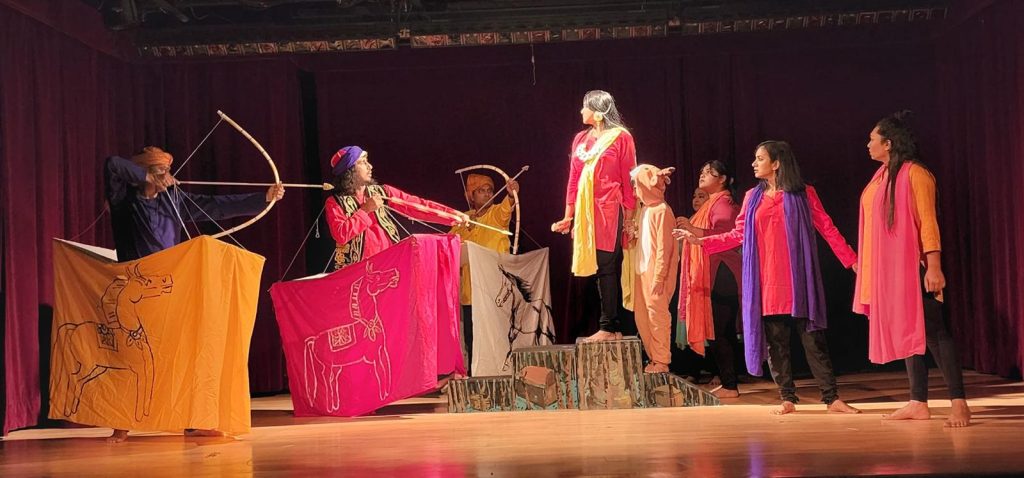
This play explores the desertion and abandonment of South Asian women by their husbands in a foreign land and in the home country as well. This is due to the global migration of workers from South Asia to the Unites States and other Western countries. The basic premise of the play is derived from research based on Manavi’s occasional Paper No. 6, Transnational Abandonment of South Asian Women: a new face of violence against women, written by Urjasi Rudra and Shamita Das Dasgupta and an article, Abandoned and Divorced: The NRI Pattern, written by Shamita Das Dasgupta published in infochangeindia.org. Two out of 10 NRI marriages reportedly end with the wife being abandoned. As noted by Ms. Das Dasgupta, “The phenomenon of wives abandoned by their NRI husbands has been growing invisibly for more than a decade. Nearly every Indian state has women deserted by NRI men who live in various foreign countries including Canada, UK, European and Middle Eastern countries, and the USA.” She further illustrates the problem by observing, “The overwhelming majority of abandoned women have no way of combating their husbands’ desertion. Many are forced to live with their in-laws as virtual servants to avoid destitution and silently suffer countless indignities. Some women are bringing up children who have never seen their fathers and a few have committed suicide to avoid the uncertainties and social shame of being abandoned. While the fundamental motivation of such behavior in men might be to dissolve an unwanted conjugal relationship, in all cases the main purpose of abandonment is to deliberately deprive women of financial and legal recourses to pursue justice. Hence, abandonment has dire and far-reaching consequences for married Indian women. It profoundly affects financial, emotional, physical, and social conditions of a woman and renders her life and livelihood practically nonviable.” In our play, we first see the motif of abandonment being displayed through the classic mythological story of Shakuntala by Kalidasa, where King Dushyanta, marries Shakuntala but forgets about her for many, many years. The play then juxtaposes the old world of South Asian women from South Asia as depicted in the epic tale of Mahabharata and the modern world of South Asian women living in the United States and in South Asia today. In the classic mythological story, a King marries a common, rural woman but completely forgets about her existence and denies her the status of being his wife. This tale of abandonment is intertwined with the various forms of misogynistic abuse, especially inflicted upon the women of South Asian immigrant community here in the US. The play will posit the question–how far have we truly progressed from thousands of years ago when abandoning one’s wife and beloved was not out of the ordinary. With the #metoo movement in perspective, it is important to unveil the horrific tales of women abandonment and abuse in the immigrant South Asian community in the US. The play will demonstrate a classic tale while deconstructing and drawing parallels to the exploitation of South Asian women living in South Asia and India today.
Written and Directed by Golam Sarwar Harun, Gargi Mukherjee
Music: Birsa Chatterjee
Lights: Babor Khademi / Ekhtiar Tamanna
Cast: Gargi Mukherjee, Shireen Bakul, Rekha Ahmed, Protima Sumi, Laila Farzana, Ajaz Alam, Basunia Sumon, Ifti Choudhury, Md. Kajal, Tasnuva Anan, Jeff Hossain, Reshma Choudhury